
Motor failures are events that do not occur silently. They disrupt the entire facility environment. They ambush production, scorch schedules, and quietly inflate maintenance spend. Industrial motors usually have damage ratings against these failures. A popular damage rating is IP65 and IP67
When buyers debate over their decision of whether to buy IP65 or IP67 rated motors, they are not arguing about a label. They are deciding how much risk they can tolerate in their specific environment. Those risks are all linked with environmental elements like dust, hose-down, rain, pooling water, or the occasional “how did it get that wet?” incident.
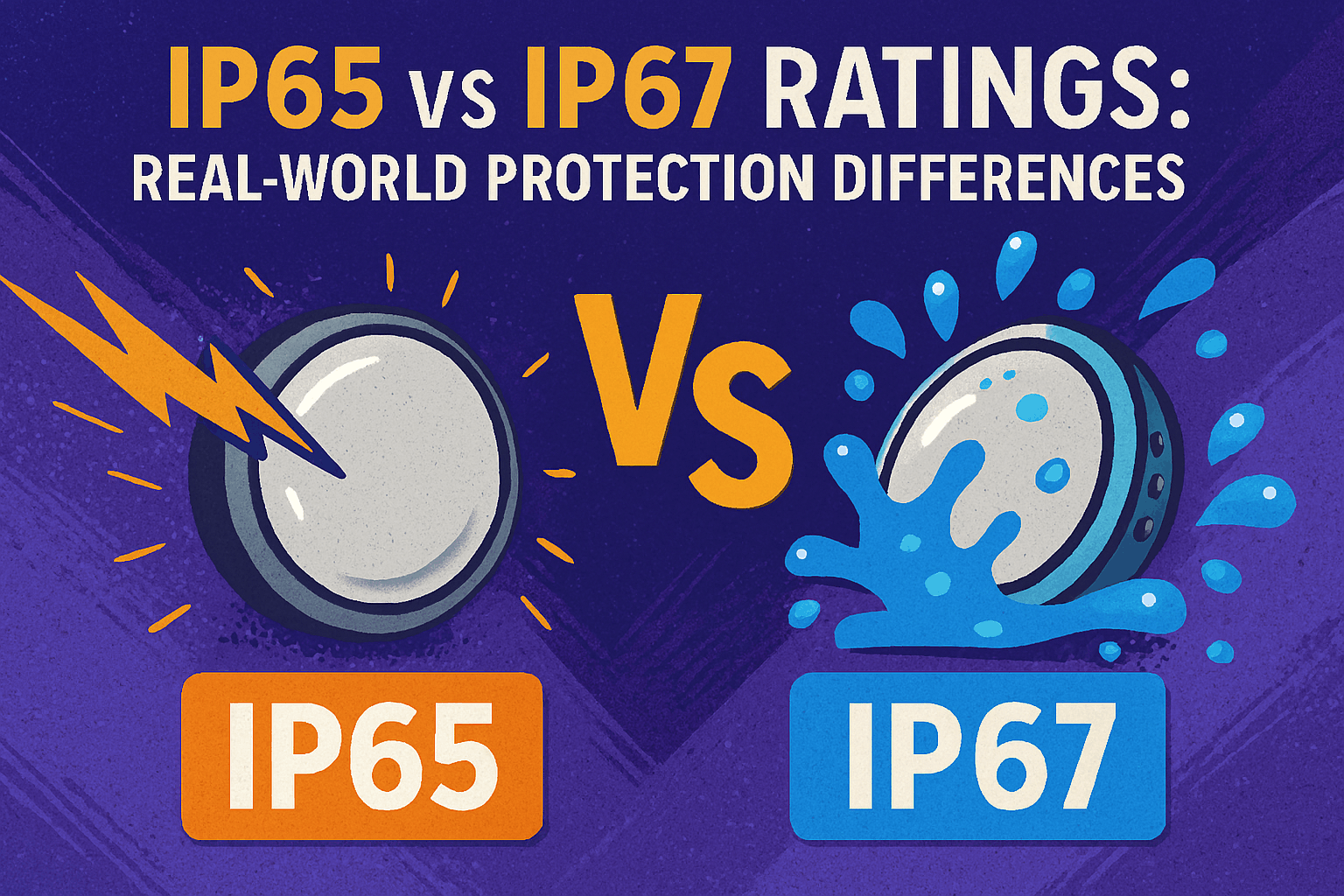
This blog helps you choose the rating that protects uptime without paying for protection you will never use. One clean frame holds: IP65 resists water jets. IP67 resists temporary immersion.
IP stands for Ingress Protection, defined under IEC 60529. The rating has two digits:
• The first digit covers solid particle protection (dust and debris).
• The second digit covers water ingress protection (from dripping to immersion).
So, when you see IP65 or IP67, you are reading two separate tests stitched together.
What the rating does not tell you and this is where buyers make the mistakes are
• Corrosion resistance (salt air, fertilizer dust, caustic wash chemicals)
• Chemical compatibility (cleaners, coolants, oils)
• Pressure cycling and thermal cycling durability (hot motor, cold rinse, repeat)
• Connector and cable entry integrity (often the actual leak point)
• Washdown suitability (high-pressure, high-temperature sanitation is its own beast)
IP is a necessary rating but it does not tell the whole story.
The “6” (dust): IP6X means dust-tight. That does not equate to “mostly dust resistant.” In practical terms, this means the motor is built to prevent dust entrance that would interfere with operation.
That matters in environments that are dest-heavy like cement, grain, woodworking, and mining support facilities. In short, anywhere fine particulate tends to get in the bearings, seals, and housings of the motor.
The “5” (water): IPX5 means protection against water jets. But this does not cover submersion in water or liquid.
An IP65 motor’ protective barrier is efficient only when water shows up as:
• Routine spray and splashing
• Hose-down motor cleaning that is controlled
• Outdoor rain exposure and wind-driven spray
Where IP65 fails is when the motor is submerged, even briefly. If water can pool around the motor, rise above the shaft line, or flood the area, then eventually IP65 will become useless.
The “6” (dust): Same dust-tight specification as IP65.
The “7” (water): IPX7 means protection against temporary immersion under defined test conditions (depth and time as specified by the standard and/or the manufacturer’s declaration).
This rating exists for environments where water is not just sprinkling around or coming in streams, but it is accumulates in one place and rises to cover the motor housing. Common areas where this can happen are pits, low points in plants, or outdoor equipment where pooling water is plausible.
But there is a limit to IP67 protection: it is not a promise of continuous submersion. The motor is meant to survive a dunk, not be immersed for extended time.
Also, immersion isn’t the only stress. Pressure changes and temperature swings can pull water past seals over time. The label does not mean invincibility against every environmental factor.
|
Decision factor |
IP65 rated motors |
IP67 rated motors |
What it means for buyers |
|
Dust protection |
Dust-tight (6) |
Dust-tight (6) |
Solids protection is equivalent on paper; your decision is mostly about water exposure. |
|
Water exposure type |
Water jets (5) |
Temporary immersion (7) |
Jets and immersion are different failure worlds. Don’t treat them as interchangeable. |
|
Best-fit environments |
Spray, splashing, controlled hose-down, outdoor rain |
Areas with pooling water risk, temporary flooding, wash-to-immersion transitions |
Choose based on the worst credible event, not the average day. |
|
Typical risk you’re managing |
Getting sprayed |
Getting submerged |
Production doesn’t stop on average days. It stops on bad ones. |
|
Common failure mode when misapplied |
Water finds cable entry or seals under aggressive jetting |
Water enters during prolonged submersion or pressure/thermal cycling |
IP67 doesn’t automatically protect you from pressure washing; IP65 won’t forgive a flood. |
|
Cost and lead-time tendency |
Often lower cost, broader availability |
Often higher cost, may have fewer variants |
Budget matters, but unplanned downtime costs more than the rating upgrade. |
|
Maintenance implications |
Regular visual checks for seal wear and cable gland condition |
Same checks, plus greater focus on connector sealing and pressure equalization strategy |
With higher protection, the “weak link” shifts to accessories and installation details. |
Scenario A: Dusty facility with occasional hose-down
This is the classic “industrial normal.” Dust is heavy. Water is present, but usually as controlled cleaning or an incidental splash.
Recommendation: IP65 is typically the right business choice. It blocks dust and handles water jets when cleaning is sane and consistent.
What to verify beyond the label:
• The cable gland/connector rating matches or exceeds the motor rating
• The motor is not mounted where water can pool around the shaft seal
• Cleaning methods do not include close-range, high-pressure blasting directly at seals
Scenario B: Outdoor equipment exposed to weather, wash, and wind-driven spray
Outdoor installs get punished in ways indoor specs don’t capture. Wind pushes water into seams. Sun bakes seals. Freeze-thaw cycles pry at interfaces.
Recommendation: Start with IP65 if the motor is not in a low point and you can prevent standing water. Step up to IP67 if water pooling or brief submersion is even moderately plausible.
What to verify beyond the label:
• Mounting orientation and drainage: where does water sit after rain?
• Breathers/vents (if present): are they rated appropriately or protected from direct spray?
• Coatings and fasteners for corrosion resistance (IP doesn’t cover rust)
Outdoor failures feel personal because they are visible. They embarrass teams. They trigger blame.
Scenario C: Pit/sump area with credible flooding or pooling risk
If the motor is located in a pit, near a trench, beside a sump, or at floor level in a wash-prone zone, assume the worst day will come. It always does.
Recommendation: IP67. This is where the rating earns its keep. You are buying resilience against temporary immersion events that can otherwise annihilate uptime.
What to verify beyond the label:
• Manufacturer-stated immersion depth and duration assumptions
• Sealing strategy at shaft interface, end caps, and especially connectors
• Whether the rest of the assembly (gearbox, encoder, junction box) matches the same ingress integrity
Industrial buying of motors is a purchase that can backfire if you don’t read the fine print in specs. The IP code is a headline. You still need the terms.
For IP67, look for clear statements around immersion parameters. If the manufacturer is vague, that means a high risk of motor malfunction that will result in costly repairs.
For IP65, inquire what “jets” means in the context of your cleaning practices. If your plant uses aggressive wash methods, the motor’s sealing system will matter more than the rating.
Ask how sealing is achieved at critical interfaces:
• Housing joints and end bells (gaskets, O-rings, sealing compounds)
• Shaft seal design and opening mechanism for serviceability.
• Any inspection covers, drains, or plugs
Seals are not unbreakable. With time they age, harden, and crack.
Many “IP failures” are not motor failures. They are installation failures.
To ensure installation is flawless, match the rating across:
• Cable glands
• M12 or other connectors
• Junction boxes and conduit transitions
• Strain relief and bend radius management
A motor can be IP67. But if the connector is faulty then it can quietly be the leak.
A tightly sealed motor can still suffer internally if it pulls in moisture through micro-gaps as it heats and cools. Condensation can form, which begins to rust the windings or sensors.
Look for:
• Stated humidity performance
• Optional breathers or pressure equalization features (with appropriate protection)
• Guidance for washdown or high-humidity environments
Mounting can change exposure to environmental elements. Shaft-down configurations can invite pooling at seals. Cable loops can act like gutters.
Choose IP65 when your reality is dust plus spray, and water does not pool or rise. It is the workhorse rating that keeps costs sane and availability broad.
Choose IP67 when temporary immersion is a credible event: pits, low points, flood-prone areas, or any setting where water can linger around the motor body. It buys time. It preserves production. It prevents those ugly, avoidable shutdowns.
One final issue to keep in mind is to evaluate the entire system, not the motor in isolation. Motor, connector, cable entry, gearbox, sensor housing, junction box. The weakest seal is the weak point in damage protection.
 810522177@qq.com


 15617522375